Put the problem into words
What was observed? What was reported? What have we assumed? Compare the explanations that fit, and be clear about the information still missing.
 Seeing AnewEliraz Levi · Clinical reasoning
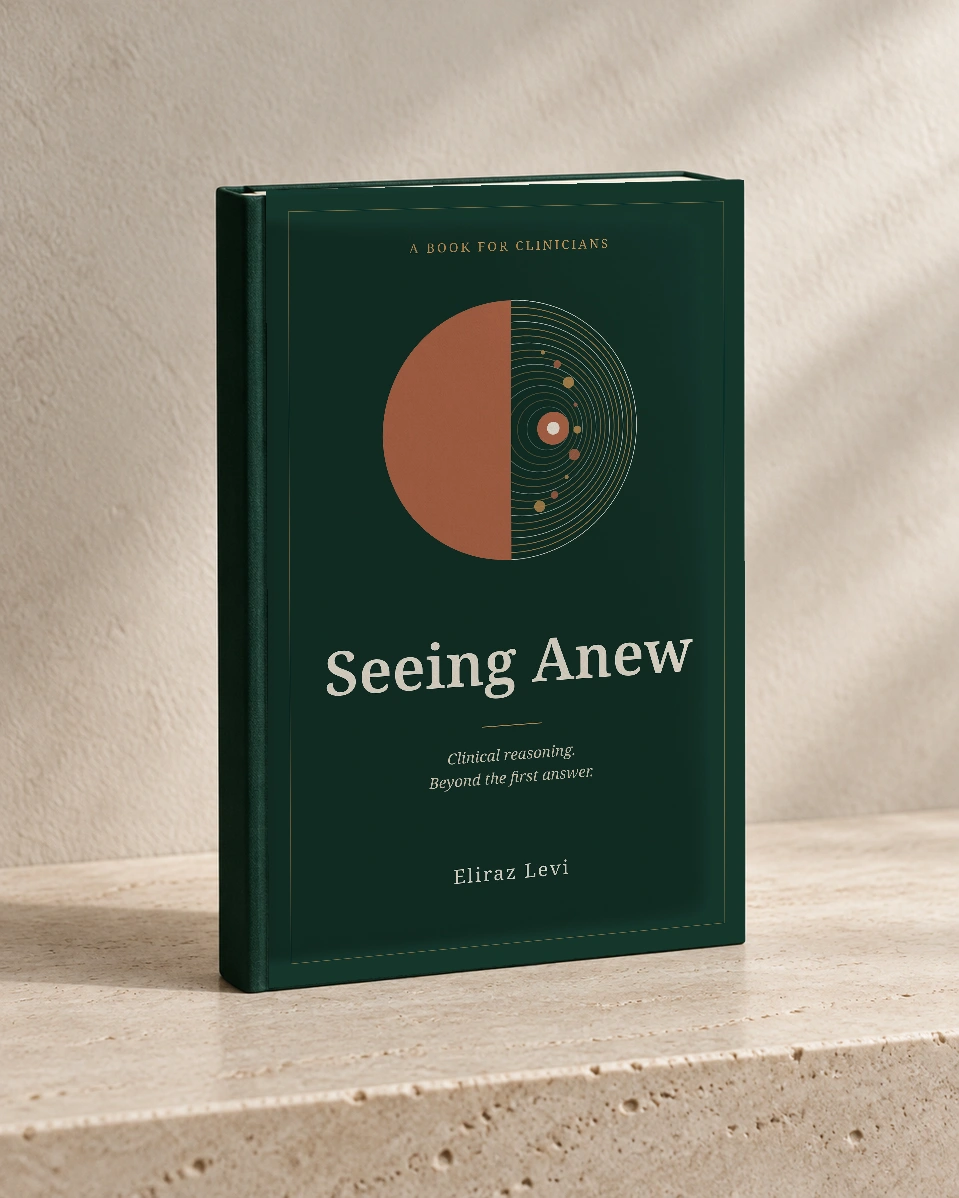
A book on clinical reasoning, for clinicians
Sometimes, a better question changes how we think.
We know a lot. But how do we use that knowledge to reach a decision? Seeing Anew invites us to think actively: ask questions, compare explanations and examine the way we reason in the clinic.
Out October 19, 2026. Kindle edition, in English.
Why this book
A patient sits down. We listen, examine and start making sense of the problem. Somewhere along the way, a possibility becomes the explanation we work with. But what made us choose it?
Seeing Anew examines the thinking behind these moments in musculoskeletal practice. How we use what we know. How a familiar story can shape our reasoning. And how we test an explanation against a detail that does not fit.
It is written for clinicians: doctors, physiotherapists, occupational therapists, osteopaths, chiropractors and professionals across clinical healthcare. It is a book about thinking in the clinic, not a guide to diagnosing or treating a particular condition.
Before moving on
Not because every decision is wrong. Because it is worth examining how we reached it.
Think of a recent patient. What did you see? What did they tell you? What did you assume because it fitted the explanation you already had?
Try separating those three things. Then ask: what information could make me think differently?
Written for this website, not taken from the manuscript. A prompt for reflection, not clinical advice.
Questions the book explores
These are questions to return to, not a formula that works for every patient.
Open a question that connects with your work.
An early diagnosis can become hard to let go of. Recognising that is useful, but naming a bias is not enough. We also need to compare other explanations, reflect on our decisions and learn from feedback.
The same complaint can have more than one explanation. Organising the problem clearly helps us bring relevant knowledge to mind. Then we can look for the findings that separate one possibility from another.
A positive finding does not settle a diagnosis on its own. Context, frequency and new information matter. If a patient improves after treatment, that does not automatically tell us why it helped.
An open mind does not mean overlooking danger. Red flags need attention. When a serious condition is a concern, assessment and referral should follow the needs of the case and our professional scope.
A measure can improve while the thing the patient cares about stays the same. Their goals, preferences and everyday life belong in the reasoning, and in the choice of what to do next.
A case is easier to explain once we know how it ends. Looking at information in stages lets us examine how an explanation changes. Cases can help us learn; they do not, on their own, prove how common or effective something is.
Back in the clinic
What we think about the problem shapes what we do next. What happens next should also shape what we think.
What was observed? What was reported? What have we assumed? Compare the explanations that fit, and be clear about the information still missing.
Consider the risk, your confidence and the patient's goals. Ask whether it is time to act, investigate, consult or refer.
What changed? What did not? Let the outcome help you update your explanation, rather than treating it as proof that you were right from the start.

About Eliraz
Physiotherapist and clinical reasoning educator
This book grows out of clinical work and teaching. Both keep bringing Eliraz back to the same question: how do we use what we know to think through the needs of the person in front of us?
He teaches healthcare professionals alongside his work as a physiotherapist. The book brings together his interest in clinical reasoning, cognitive biases and the patient encounter. The aim is to examine how we think, not to point out who got it wrong.
Who it is for
You may be starting out and trying to organise what you have learned. You may have years of experience and want to examine habits that have become familiar. Or you may teach and want to discuss how a decision was reached.
The examples focus on musculoskeletal practice. The questions about listening, uncertainty and patient goals are intended for professionals working in clinical healthcare settings.
Before you read
No. It is about clinical reasoning. It does not provide treatment protocols or replace training, clinical guidance or professional assessment of a case.
Biases are an important part of it, but they are not the whole story. The book connects them with clinical examples and ways to examine a decision. Knowing the name of a bias does not fix it, and not every error is caused by bias.
English. Seeing Anew comes out on October 19, 2026.
From October 19, 2026, as a Kindle book: Seeing Anew on Amazon. This website does not take payments.
Out October 19
You can write to Eliraz with a question or to ask about the book.
This opens your email app. It does not send a message automatically, sign you up to a list or place an order. The site does not collect your email address.